
Oklahoma City Resident Lookup Records
A careful Oklahoma City resident lookup uses a record for the question that record can answer. The Oklahoma County Assessor can connect a person to a current parcel and tax-roll mailing address, while the Oklahoma Voter Portal is designed to confirm one known voter with a full name and date of birth. Court, vital-index, deed, business, and license records place names in separate contexts. A match in one system is a lead, not a final identity decision.
| Oklahoma City record | What it can confirm | Custodian route | Access boundary |
|---|---|---|---|
| Assessor account | Current parcel owner, situs, mailing address, and legal description | Oklahoma County Assessor Public Access | Public search; a mailing line is not proof of residence |
| Voter registration | Status and district context for one known voter | Oklahoma Voter Portal | First name, last name, and date of birth required |
| Court docket | Party role, case number, event dates, and docket activity | OSCN and the Court Clerk | Index may be public; files or certified copies route to the clerk |
| Vital index | Birth or death event, county, date, and name lead | OK2Explore | Free index; certificates follow statutory access rules |
| Business filing | Entity and filing detail where the filing displays it | Secretary of State search | Entity facts are not automatically a home address |
Start with the least ambiguous known fact. A full name plus approximate age, address, or date is more useful than a broad name-only search. If the person owns no county parcel, an absent assessor hit does not establish that the person has no Oklahoma City connection.
Search Oklahoma City Names in OSCN
OSCN’s docket search is the main Oklahoma County District Court route for party-name research. It supports court selection, case number, first, last, and middle name, birth-date ranges, party type, case type, and filed or closed date ranges. Narrowing a common name by court and date is safer than assuming the first hit belongs to the intended person. A docket identifies a case trail, not present residence.
| Last and first name | Optional party-name fields; run middle-initial and spelling variants separately. |
|---|---|
| Born on or after / before | Optional range that can separate people sharing a name. |
| Case type and party type | Optional filters that distinguish the role and docket category. |
| Filed or closed dates | Optional date pairs for a defined time window. |
| Result record | Case number, party role, filing events, disposition, and document links when available. |
Sealed, juvenile, expunged, adoption, and protected family material is not an ordinary public result. When a web docket lacks the needed image, the Oklahoma County Court Clerk can take a request for the case file, document title, parties, aliases, and approximate filing date. Certified copies cannot be sent by email.
Oklahoma City Municipal Record Route
The Oklahoma City Municipal Court ticket lookup is narrower than OSCN. It concerns payable municipal records, and the city cautions that new cases may take three to five days to appear while payments can take 24 hours. If a record is not shown, use the municipal record search or the court’s official customer-service route instead of treating the initial result as complete.
Oklahoma City Municipal Court’s lookup screen is shown below.
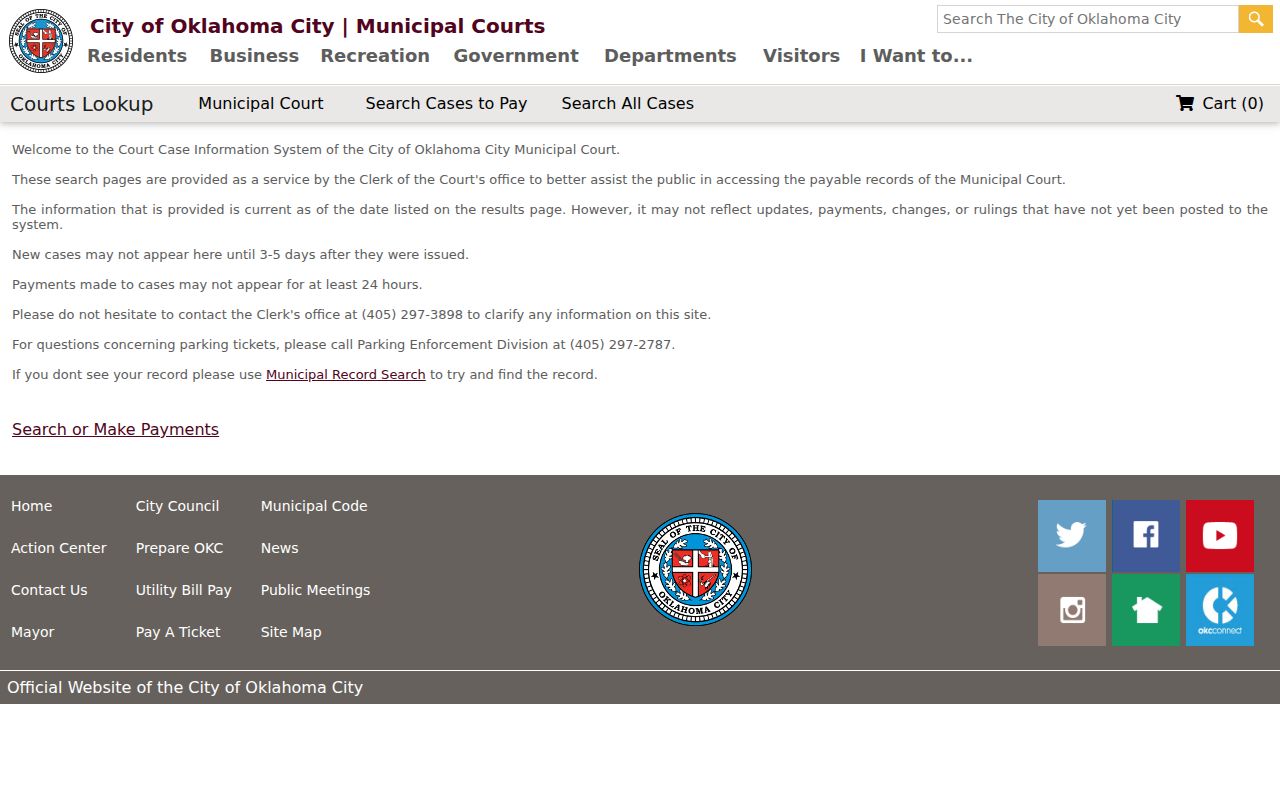
The screen is a route to payable municipal matter information, so it should be used with the city’s timing warning and not confused with the Oklahoma County District Court docket.
Verify an Oklahoma City Resident Record
Verification means finding at least two independent anchors that agree. For a current Oklahoma City question, compare a name and known address with an assessor account or, for a known voter, the three-field voter portal. Then test name variants in OSCN or a dated filing. An assessor owner may be absent from the property, a voter record indicates registration rather than every household member, and a court party may have moved. Keep the source role visible in the notes.
For a historic Oklahoma City question, shift the order. Start with the old address and date, then compare an OHS directory row, census material, a newspaper notice, or a recorded instrument. The OHS catalog identifies Oklahoma City directory rows from 1889 through 2003, while the Criss Cross material can provide an address-led lead for selected later years. A later obituary or probate filing can identify a family or representative, but its address is a dated filing fact rather than an automatic current-residence claim.
- Write the full name, known address or approximate age, and the date each fact was learned.
- Search the Assessor by name or physical address and capture the account, situs, mailing line, and legal description.
- For a known voter, use first name, last name, and date of birth in the Oklahoma Voter Portal; do not use it as a broad household list.
- Search OSCN with spelling variants and bounded dates, then compare the party role and case timing with the first source.
- Use an index or clerk request only for the specific event or record that the two anchors support.
- Docket
- A court’s dated list of case events, parties, filings, and outcomes. It may point to a file without displaying every document.
- Index and image
- An index is a searchable record list. An image is the scanned or viewed document, which may have separate access and redaction rules.
- Certified copy
- A custodian-issued copy carrying the certification required for an official purpose; it is different from an ordinary reference copy.
Keep a short research log: query date, portal, exact spelling, filters, result, record number, URL, and the reason the result does or does not fit the person. That record is valuable when a portal updates, an entry changes form, or a same-name person appears in another Oklahoma County source. If the facts do not converge, leave the match unresolved and ask the appropriate custodian what identifiers can be verified.
Oklahoma City Vital Index Checks
OK2Explore is a free Oklahoma birth and death index. Its search fields include event type, event date, county, subject name, and sex. Birth data enters the online index after 20 years and death data after five years. The index can establish that a record may be on file, but it is not a certificate order and it does not override eligibility rules.
Oklahoma birth certificates generally become public after 125 years and death certificates after 50 years under 63 O.S. §1-323. Restricted copies require the appropriate relationship, identification, and proof. The OSDH route lists a $15 standard search and copy fee, while the Court Clerk handles certified marriage license copies for $2 and court-file copies through its own request process. Keep a birth, death, marriage, and divorce record in its correct custodian lane.
Oklahoma City Filing Name Checks
When a name is tied to an organization, the Oklahoma Secretary of State Business Entities Search offers an entity-name search and an Advanced Search link. Follow a result through its filing number only when the displayed filing identifies the relevant entity. A registered agent, officer, or business address can be a useful record fact, but it should not be recast as a personal-address conclusion.
The Secretary of State entity-search interface is shown below.
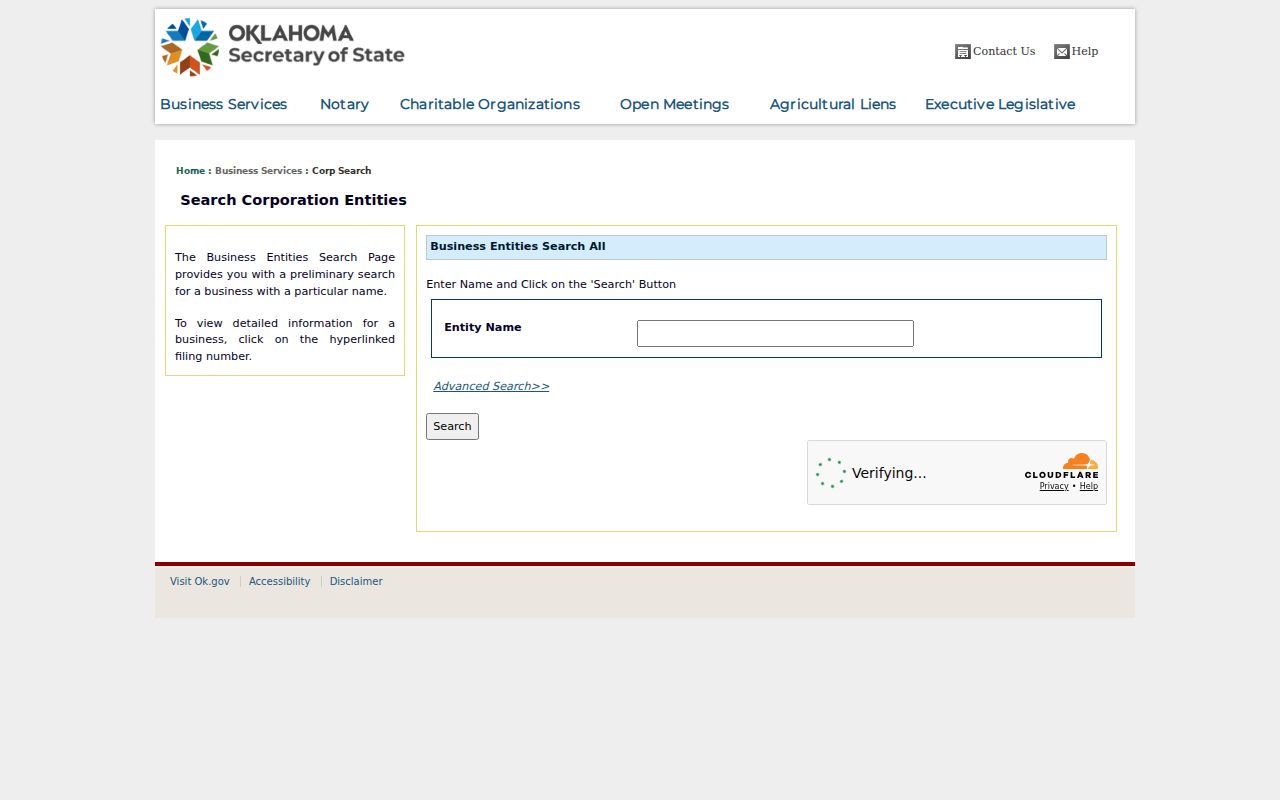
The filing-number path helps distinguish a real entity record from a same-name result, especially when a person has a common name.
Protected Oklahoma City Resident Records
Some gaps are intentional. Oklahoma’s Address Confidentiality Program can shield eligible participants, and the State Election Board’s Restricted Records Program under 26 O.S. §4-115.2 protects qualifying people and their immediate families. ACP voter participants have name and address removed from public lists and vote absentee-only. Protected voting records should be treated as a legal privacy outcome, not as an invitation to reconstruct an address from unrelated records.
For a record not available online, a focused Oklahoma Open Records Act request can identify the record type, person or property, date range, search terms, and desired copy. The law provides prompt, reasonable access subject to exemptions and direct-copy costs, but agencies need not create a custom report. The appropriate fallback may be the Court Clerk, Vital Records Service, County Election Board, library, or State Archives.
Use the direct channel that fits the missing record. The Court Clerk’s request form can use case, marriage, party, alias, and approximate-date details. The State Election Board asks for an identifiable record, time frame, and specific search terms. Library and archive staff can help locate a catalog item or reading-room source when no online index exists. A precise request is more useful than a broad demand for every record associated with a person.
Limits on Oklahoma City Resident Lookup
Use a resident lookup for personal, lawful research such as reconnecting with family, documenting a historical household, or checking a record against its official custodian. Do not use a public-record lead to stalk, harass, intimidate, or harm anyone. Public records change, indexes make mistakes, and a nonmatch can reflect a protected file, a name variation, an unindexed older book, or a record held only at the counter.
Lawful use. Oklahoma City resident records can support careful personal research, but protected addresses, sealed files, and restricted certificates must remain protected.
When a record is wrong, contact the custodian holding that record with the exact identifier and factual correction. Assessor corrections belong with the Assessor, docket corrections with the Court Clerk, voter updates with the state or county election office, and vital amendments with OSDH. A commercial compiled profile is not a certified public record and should never replace that correction path.